How We Teach Mathematics at Beacon Primary School
In Nursery our children follow White Rose 'Master the Curriculum' which provides a rich, practical and engaging learning journey that build strong mathematical foundations for future success. The curriculum is designed to develop children's understanding of number, pattern, shape measure and mathematical language through meaningful experiences, play and exploratiob. Maths is woven throughout the Nursery environment, ensring that children encounter and apply mathematical concepts in both adult-led learning and child-initiated play.
We believe that every child can develop confidence and enjoyment in mathematics. Through carefully sequenced learning opportunities, children build their understanding step by step, revising key concepts regularly so that knowledge becomes secure. Children are encouraged to explore mathematical ideas through practical resources, stories, songs, rhymes and real-life experiences. Whether they are counting objects, comparing quantities, building with blocks, creating patterns, measuring ingredients in the mud kitchen or discussing shapes in their environment, mathematics becomes meaningful and relevant to their everyday experiences.
Language development is at the heart of our maths provision. Staff model and reinforces mathematical vocabulary throughout the day, encouraging children to talk about what they notice, explain their ideas and use matahematical language with increasing confidence. This supports both mathematical understanding and communication skills.
Our teaching promotes the Characteristics of Effective Learning. Children are supported to:
- - Play and explore through practical investigation
- - Think critically by identifying patterns, making connections and solving problems
- - Remain engaged and motivated as they persevere with challenge and celebrate success
From Reception to Year 6, mathematics is taught though the Power Maths programme, published by Pearson and developed in partnership with leading maths specialists. The schme is fully alighned to the National Curriculum and reflects the principles of teaching for mastery, ensring that all pupils develop a deep, connected and secure understanding of mathematical concepts.
Our curriculum is built around the belief that every child can succeed in maths. Learning is carefully sequenced so that pupils develop fluency, reasoning and problem solving skills through small, manageable steps. This approach enables children to build upon their prior knowledge, make meaningful connections and gain confidence as mathematicians.
Each lesson follows a consistent structure that promotes high-quality teaching and learning. Lessons typically begin with a Power-Up activity where pupils are presented with a problem, or real-life context designed to stimulate retrieval of knowledge and promote mathematical thinking. Through skilled questioning, teachers encourage discussion and exploration, enabling pupils yo identify patterns, explain their thinking and develop mathematical language. Following this, the teacher explicitly introduces new learning modelling key concepts and strategies using concrete, pictorial and abstract representations. Manipulatives and visual models are used purposefully to support understanding, ensuring that pupils can see structure rather than just memorising procedures. Learning is guided and scaffolded through carefully selected examples and discussions allowing pupils to articulate their reasoning, challenge misconceptions and deepen their understanding.
Tasks are designed to develop fluency while also providing opportunities for reasoning and problem-solving. Teachers continually assess understanding during lessons, responding promptly to misconceptions and adjusting support where needed. Pupils are encouraged to explain their methods, justify their answers and compare different approaches, helping them to become confident and reflective learners.
Opportunities for challenge are embedded throughout learning rather than provided as separate extension activties. Pupils who grasp concepts quickly are encouraged to think more deeply, expalin generalisations and solve increasingly more complex problems.
Teachers use ongoing formative assessment, questioning, observation and feedback to inform teaching and identify next steps. Regular summative assessment is used to help monitor progress and ensure that knowledge and skills are secure befor pupils move on to new concepts.
Vocabulary development is a key feature of mathematics teaching. Mathematical language is explicitly taught, modelled and revisited to ensure that pupils can communicate their thinking with precision. Sentence stems, partner discussion and oracy opportunities support all learners, including those with additional needs and pupils who are developing their language skills.
Number Sense and Fluency Facts
-
Number sense is a deep understanding of number and how numbers work. It involves recognising patterns, understanding relationships between numbers, seeing number structures and being able to use this knowledge efficiently when solving problems. Children with strong number sense do not simply memorise procedures; they understand why mathematics works and can apply their knowledge in different contexts.
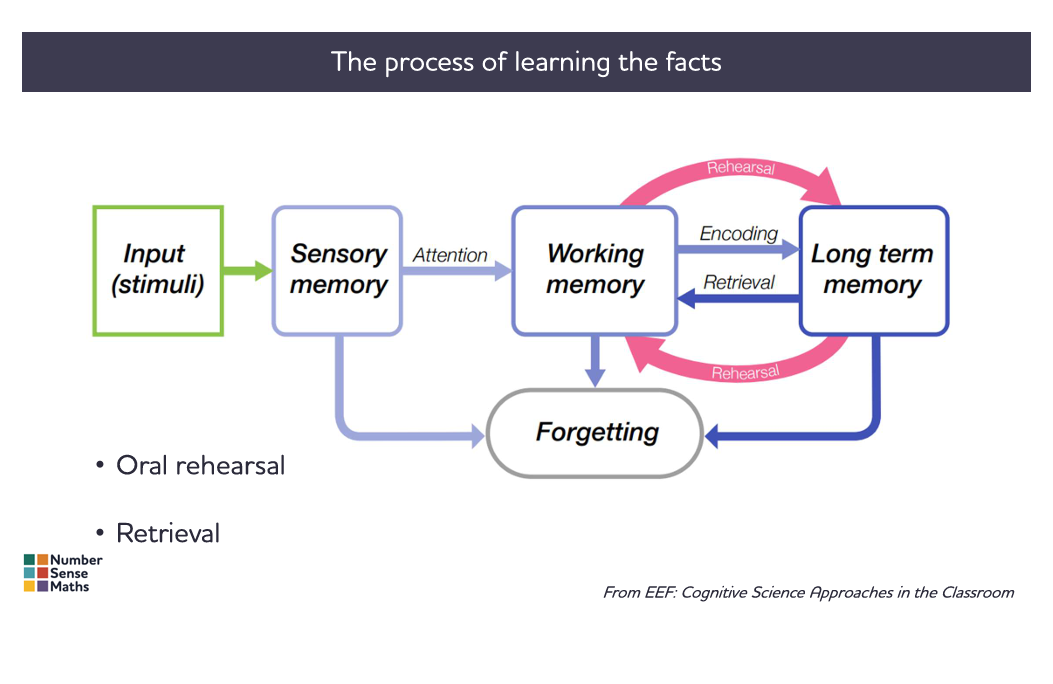
Alongside this, children develop fluency facts. These are the key number facts that pupils learn to recall accurately and efficiently, including number bonds, addition and subtraction facts, multiplication tables, division facts and important place value relationships. When children know these facts automatically, they can focus more of their thinking on reasoning, problem solving and mathematical enquiry.
Our approach to teaching number sense and fluency is carefully structured and progressive from the Early Years through to Year 6. Through daily practice, practical resources, mathematical talk, games, investigations and purposeful retrieval activities, children develop both confidence and accuracy. We encourage pupils to explain their thinking, compare strategies and make connections between different areas of mathematics, helping them to develop a deeper understanding rather than relying on memorisation alone.
Throughout the curriculum, children are supported to:
- Recognise patterns and relationships within numbers.
- Develop flexibility when choosing efficient calculation strategies.
- Recall key number facts quickly and accurately.
- Apply their knowledge to increasingly complex problems.
- Reason, justify and explain their mathematical thinking.
- Build confidence and resilience as mathematicians.
-
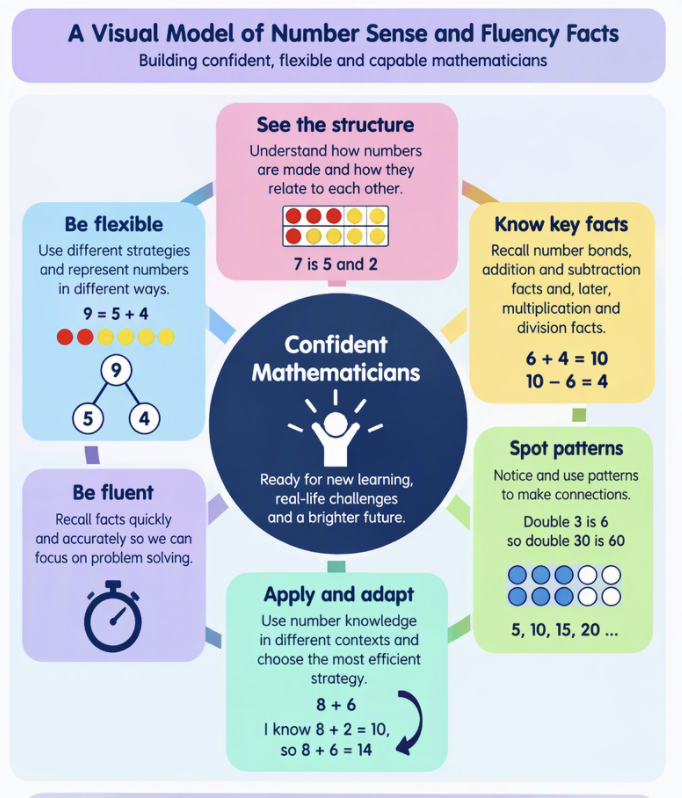 By prioritising number sense and fluency, we ensure that pupils develop secure mathematical foundations that support future learning across all areas of mathematics. Our aim is for every child to leave our school as a confident mathematician who can think flexibly, solve problems effectively and approach mathematical challenges with curiosity and independence.
Supporting Pupils with the Multiplication Tables Check (MTC)